
Society often tells us that aging means slowing down, stepping back, and accepting decline. We fundamentally reject that narrative.
At NEVERQUIT 60, we believe that the later chapters of life should be defined by strength, capability, and purpose. We use the discipline of martial arts not to fight others, but to fight the physical and mental decline that comes with inactivity.
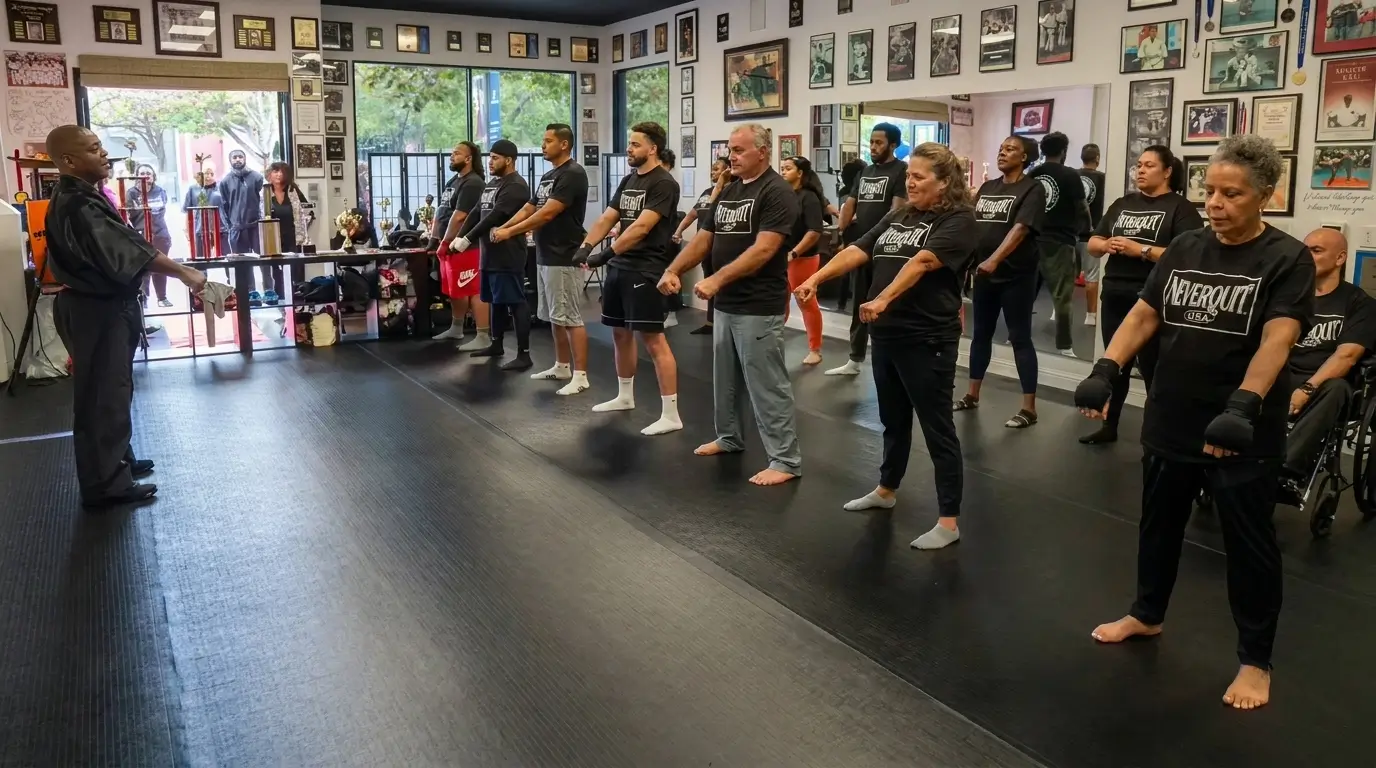
For our members living with Parkinson's, movement isn't
just exercise—it's a vital intervention.
Large amplitude movements, rhythmic striking, and complex
footwork help bypass neurological blocks. We train the body to
remember how to move big, how to move fast, and how to
move with intention. It is proactive, aggressive care for the
nervous system.
Everything we do inside the studio is built upon these three non-negotiable principles.
Physical & Mentalimpact.
We build the functional strength required to carry groceries, get up from the floor, and navigate the world with confidence. But more importantly, we build the mental strength to face the challenges of aging without fear.
The Will to Continue
Resilience is the core of the martial arts spirit. It is the understanding that progress is not linear, that setbacks happen, but that we show up anyway. We train the mind to keep going when the body wants to quit.
Shared Struggle
Isolation is a health crisis for older adults. We combat it through shared physical effort. When you sweat together, encourage each other, and hold each other accountable, you build bonds that cannot be broken.
We don't just throw punches to burn calories. Every drill, every combination, and every class structure is designed with specific cognitive and physical adaptations in mind.
Learning complex, cross-body movements forces the brain to adapt and create new neural connections, keeping the mind sharp.
Responding to pad cues improves cognitive processing speed and physical reaction time, crucial for fall prevention.
Kicking and pivoting require dynamic single-leg stability, directly translating to better balance for all types of tasks in everyday life.
Memorizing combinations requires focus and working memory, providing a workout for the brain as much as the body.
We keep our groups small intentionally. In a large gym, you can hide in the back row. Here, you are seen. You are encouraged. You are held accountable. When you don't show up, we notice. When you achieve a new milestone, we celebrate together.
Class sizes are kept intentionally small so every member gets coaching, attention, and care.
We know your name, your goals, and your story. Nobody hides in the back row here.
When you don't show up, we notice. Showing up is half the work — and we hold each other to it.
Every new combination, every personal best — wins belong to the whole community.